Example application
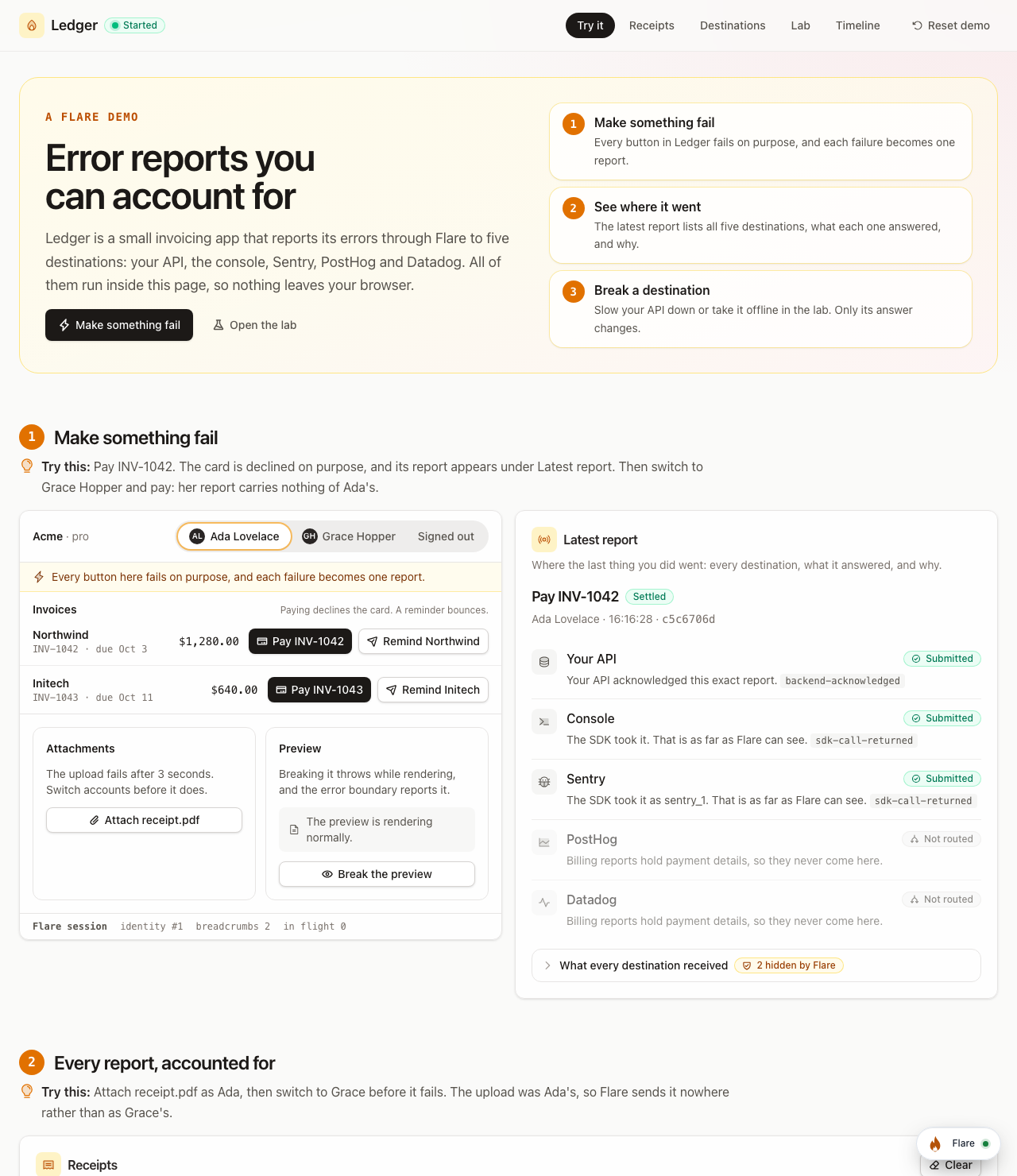
Ledger is an invoicing app for two companies. Pay an invoice, send a reminder, attach a receipt or break the invoice preview, and follow each report: redacted before any destination sees it, routed to the destinations that should have it, and settled with an outcome for each one.
Every destination is a real Flare adapter: your API through @priemskiyyy/flare-http, the console, and Sentry, PostHog and Datadog over SDKs simulated in the page. Nothing leaves your browser, and no provider account is needed.
Run it
There is no hosted demo. From the repository root:
pnpm install
pnpm build
pnpm --filter example-react dev
The example uses the built packages, so build them first.
The tour
The page walks through five sections, each with a "Try this" hint:
- Make something fail. Ledger opens signed in as Ada at Acme, and every button fails on purpose: paying declines the card, a reminder bounces, the upload times out, and breaking the preview throws while rendering. The report appears beside the app under Latest report, with every destination, what it answered and why, and the name Flare's API gives that answer. A destination that routing left out shows as Not routed. What every destination received opens the report as it was sent, with each value Flare hid highlighted.
- Every report, accounted for. Every receipt stays listed and opens to the same detail, above a legend of what each answer means. An upload started as Ada and finished as Grace is dropped as
stale-scoperather than charged to Grace. - One report, five destinations. Billing reports go only to your API, Sentry and the console. Everything else goes to Sentry, PostHog, Datadog and the console. A reminder is a message, which PostHog and Datadog skip as
unsupported-report-kind, and its email address arrives scrubbed. Flush shows how far each destination's own flush got. - Break the destinations. Slow your API past the 3 second timeout and its outcome is
indeterminate, notfailed. Take it offline and only its outcome fails. Make PostHog's own filters drop every event, report the same error twice, or restart with Sentry uninitialized and watch its reports wait for a retried start. - Watch it happen. The timeline is Flare's diagnostics stream, in words: destinations opening, reports accepted and each answer, with no report content. Restart without starting, pay, then press Start: the report waited in the buffer.
Reset demo in the header starts over. The devtools button in the corner opens Flare's own inspector over the same runtime.
What it configures
examples/shared/ledger/reporting/createLedgerFlare.ts holds all of Ledger's reporting, with its schema and privacy rules beside it in constants/:
- a
defaults.tofunction that sends reports taggedarea: "billing"to your API, Sentry and the console, and everything else elsewhere - a Zod schema for its tags, contexts and breadcrumbs, including the
reactandvuecontexts those error boundaries add redactthat keeps the defaults and adds the IBAN, and ascrubthat replaces email addresses- a
timeoutof 3000 ms, short enough for the lab's slow API to end unconfirmed
To use a real provider, swap a simulated SDK for the one your application initializes, such as sentry({ sdk: Sentry }) after Sentry.init, and give the HTTP adapter a request over your own API client. Nothing else in the app changes. The example's README maps each part of the page to its source.
Vue, Solid, Svelte and Expo
The same Ledger runs on every binding, over the same shared domain:
pnpm --filter example-vue dev
pnpm --filter example-solid dev
pnpm --filter example-svelte dev
Each web version is the app and its latest report: FlareProvider, FlareErrorBoundary around the preview, useFlareStatus in the header, useDestinationStatus beside each destination's answer, and the devtools through the binding's wrapper. The receipts, the lab and the timeline are the React page's alone.
The Expo app is Ledger on React Native. Its reports leave the app: your API is a fixture server on your computer, reached over HTTP, with the console beside it. Start the server, then the app:
pnpm dev:server
pnpm --filter example-expo dev
The app flushes when it goes to the background, and the server can be taken offline or slowed down while the app runs, as its README shows. The examples README lists every example.
Tests
pnpm test:unit runs the example's tests in jsdom with the rest of the workspace. They start Ledger the way the page does and drive the flows through the buttons, with a fresh backend and runtime per test: routing, including a destination it leaves out, redaction and the payload's highlights, skipped messages, the error boundary, a stale scope, an offline or slow API, account isolation, the startup buffer, dedupe and the timeline's wording.
pnpm test:examples builds the packages and drives the built page in Chromium with Playwright (examples/ledger.spec.ts). At 375 and 1280 px wide, a payment settles with no page errors and no horizontal scroll, reaching your API and leaving PostHog out. It also checks that the payload shows the card token and the IBAN as [Redacted] and marks both, that an upload outliving an account switch is dropped as stale-scope, that Reset demo starts over signed in as Ada, and that the devtools open and list all five destinations. examples/frameworks.spec.ts drives the Vue, Solid and Svelte builds the same way: a payment routed away from PostHog, a broken preview reported by the boundary, a stale-scope upload, a phone width without horizontal scroll, and the devtools. Neither is part of pnpm check.
The Vue, Solid and Svelte examples have their own jsdom tests in pnpm test:unit, and so does the fixture server. The Expo app is typechecked and bundled for web, iOS and Android, and has not run on a device.